
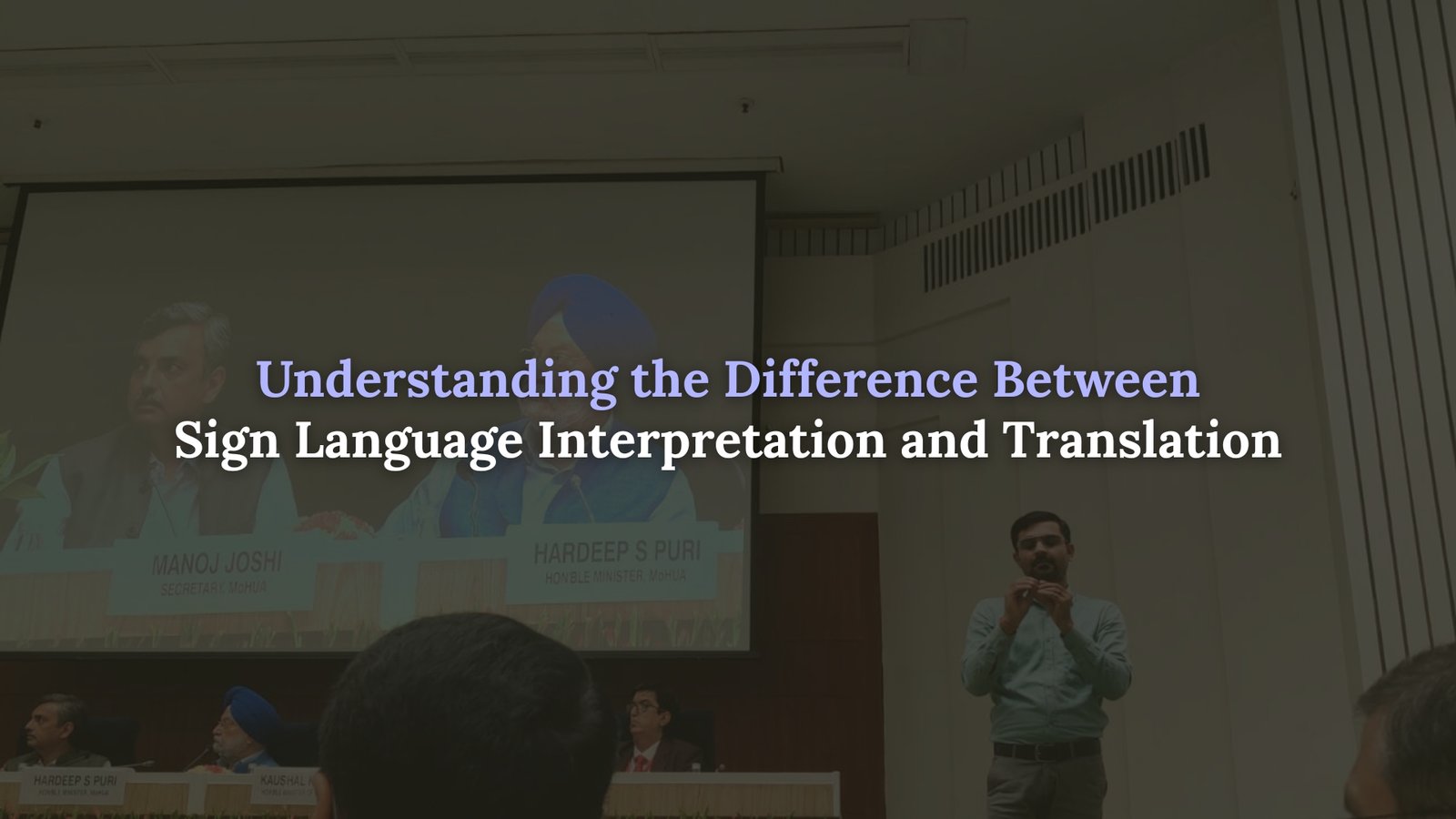
Effective communication is the foundation of an inclusive society. For the Deaf and hard-of-hearing community, accessibility depends on professional language support that bridges communication gaps. However, many people use the terms sign language interpretation and sign language translation interchangeably, even though they are two distinct services with different purposes.
Understanding this difference is essential for businesses, educational institutions, healthcare providers, government organizations, and event organizers that want to create truly accessible environments. Professional Sign Language interpretation services in India ensure that communication happens seamlessly in real time, while translation focuses on converting recorded or written content into sign language for future use.
At Lexiversa, accessibility goes beyond communication. The company offers professional Indian Sign Language (ISL) interpretation, multilingual translation, localization, and communication solutions that help organizations build inclusive experiences for everyone.
What Is Sign Language Interpretation?
Sign language interpretation is the process of converting spoken language into sign language—and vice versa—in real time. A trained interpreter listens to the speaker and immediately conveys the message using Indian Sign Language (ISL), allowing Deaf participants to engage in conversations without communication barriers.
Interpretation requires excellent language proficiency, quick thinking, cultural understanding, and subject-specific knowledge because there is no opportunity to revise the message once it has been delivered.
Professional Sign Language interpretation services in India are commonly used for:
- Corporate meetings
- Business conferences
- Educational institutions
- Healthcare consultations
- Court proceedings
- Government events
- Webinars and virtual meetings
- Public seminars
The interpreter’s role is not to simplify or modify the message but to accurately convey its meaning, tone, and intent while maintaining confidentiality and neutrality.
What Is Sign Language Translation?
Unlike interpretation, sign language translation involves converting written or recorded content into sign language. Instead of happening live, translation is carefully prepared, reviewed, and recorded to ensure maximum clarity and accuracy.
Examples include:
- Employee training videos
- Safety demonstrations
- Government awareness campaigns
- Educational content
- Product tutorials
- Website accessibility videos
- Public service announcements
Since translators have time to review the content before delivery, they can ensure that complex information is presented clearly and naturally in Indian Sign Language.
Translation focuses on creating accessible content that can be viewed repeatedly, making it ideal for long-term communication resources.
Sign Language Interpretation vs Translation: Key Differences
Although both services improve accessibility, they differ in several important ways.
1. Real-Time vs Prepared Content
Interpretation happens live during conversations or events.
Translation is completed before publication and is generally used for recorded videos or written materials.
2. Speed
Interpreters work instantly while listening to the speaker.
Translators have time to analyze, edit, and refine the final content.
3. Purpose
Interpretation supports two-way communication.
Translation creates accessible resources for repeated use.
4. Environment
Interpretation is ideal for meetings, interviews, conferences, and healthcare appointments.
Translation works best for educational materials, training videos, marketing campaigns, and awareness content.
Why Businesses Need Professional Sign Language Interpretation
Accessibility is becoming an essential part of modern business. Companies are increasingly recognizing that inclusive communication improves customer experience, employee engagement, and brand reputation.
Professional Sign Language interpretation services in India help organizations:
- Ensure equal participation during meetings
- Improve communication with Deaf employees and customers
- Meet accessibility goals
- Enhance workplace inclusion
- Deliver better customer experiences
- Build trust with diverse communities
Whether the interaction takes place in person or online, skilled interpreters enable meaningful communication without delays or misunderstandings.
Why Translation Is Equally Important
Many organizations focus only on live interpretation while overlooking the importance of accessible digital content.
Today’s audiences consume information through websites, social media, learning platforms, and video content. Without sign language translations, a significant section of the population may be unable to access important information.
Professional translation services help organizations create:
- Accessible onboarding videos
- Educational courses
- Corporate communication videos
- Public awareness campaigns
- Healthcare information
- Compliance training
- Digital learning resources
These materials remain accessible long after they are published, making translation a valuable long-term investment.
Choosing the Right Service
The right choice depends entirely on your communication needs.
You should choose interpretation if:
- Your audience needs to communicate live.
- Questions and answers will take place.
- Meetings or conferences are happening in real time.
- Immediate communication is required.
You should choose translation if:
- The content is pre-recorded.
- The information will be viewed repeatedly.
- Accessibility videos are being created.
- Educational or marketing materials need sign language versions.
Many organizations actually require both services to provide complete accessibility.
Why Accuracy Matters
Sign languages are complete natural languages with their own grammar, structure, and cultural context. They are not simply hand gestures representing spoken language word for word. Resources from the Indian Sign Language community emphasize that Indian Sign Language (ISL) has its own linguistic system and should be interpreted by trained professionals.
Professional interpreters and translators understand:
- Indian Sign Language grammar
- Cultural nuances
- Facial expressions
- Body language
- Contextual meaning
- Technical terminology
Using untrained individuals or relying solely on automated tools can result in misunderstandings, inaccurate messaging, and poor accessibility.
How Lexiversa Supports Accessible Communication
Lexiversa specializes in helping organizations communicate effectively across languages while promoting accessibility and inclusion.
Its services include:
- Indian Sign Language interpretation
- Multilingual translation
- Localization services
- Conference interpretation
- Corporate communication support
- Webinar interpretation
- Educational accessibility solutions
- Healthcare communication support
The team works with businesses, educational institutions, healthcare providers, and organizations looking to build inclusive communication experiences through professional language services.
The Future of Accessible Communication in India
India is steadily moving toward greater accessibility across workplaces, educational institutions, healthcare facilities, and public services. As awareness grows, organizations are investing more in inclusive communication strategies that support equal participation for everyone.
Professional Sign Language interpretation services in India are playing a vital role in this transformation by enabling seamless communication between Deaf and hearing communities. When combined with high-quality sign language translation, these services help organizations create environments where information is accessible, participation is encouraged, and no one is left behind.
Accessibility is not just about meeting standards it is about creating meaningful human connections and ensuring every individual has an equal opportunity to communicate, learn, and contribute.
Conclusion
Understanding the difference between sign language interpretation and translation helps organizations choose the right solution for every communication need. Interpretation enables real-time conversations, while translation creates lasting accessible content. Together, these services build stronger, more inclusive communication across workplaces, educational institutions, healthcare settings, and public spaces.
If your organization is looking to improve accessibility and communicate confidently with the Deaf community, Lexiversa offers professional solutions designed to meet your unique requirements. Get in touch with our team today to learn more about our services and discover how we can help you create a more inclusive future.